Hippolytus Revived as Virbius
Metamorphoses (Ovid Edition)Hippolytus Revived as Virbius is a compact drama of accusation, death, medical resurrection, and metamorphic rebirth. Its decisive significance lies in the way Hippolytus’s return does not simply restore the man who was destroyed: the god who revives him also changes his appearance, removes his former name, and places him within a new sacred identity as Virbius. The episode therefore turns a tragic punishment into a transformation of status, body, memory, and place.
The Recalled Tragedy and Its Cause
The account is presented as a remembered example offered to assuage another sufferer’s grief. The speaker introduces his own history as a case through which pain may be compared and endured, then recalls what happened to Hippolytus. His catastrophe begins not with a proven crime but with an accusation: Phaedra charges him with offenses that she herself desired, and Theseus accepts the charge. Hippolytus is expelled from Theseus’s home under a heavy burden of curses despite being guiltless.
His exile drives him toward Troezen, specifically Pitthëan Troezen’s land. The movement away from Theseus’s household gives the story a clear causal progression: desire becomes accusation, accusation becomes paternal judgment, and judgment becomes banishment. The curses do not merely accompany his departure as emotional language; they help define the hostile force that follows him beyond the household and prepares the fatal reversal of his journey.
The Chariot’s Destruction and Death
Hippolytus’s death occurs while he is driving untamed horses. At first, the animals’ headlong rage is brought under his strength, suggesting that the danger might be mastered. The apparent recovery is overturned when a stump catches in the spokes. The obstruction tears the shattered wheel from its axle, and the violent shock throws Hippolytus from his seat.
The episode concentrates tragedy in a single mechanical detail. The stump is not an abstract decree of fate but a physical interruption that converts motion into destruction: the chariot’s wheel breaks, the vehicle loses its structure, and the driver is cast down. His death follows the earlier injustice of his exile, so the accident appears as the final consequence of a curse imposed on an innocent man rather than as punishment proportionate to any guilt established in the narrative.
Descent and Restoration
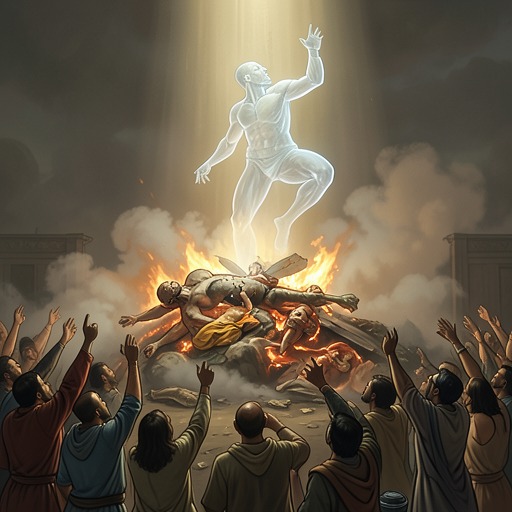
After the crash, Hippolytus sees the dark realms of woe and bathes his wounds in smoking streams below. His passage into the underworld is described as a genuine second death, not merely a moment of unconsciousness. He says that he would have remained there without another life, a condition that emphasizes the apparent finality of the punishment and makes the intervention that follows a direct defiance of mortality.
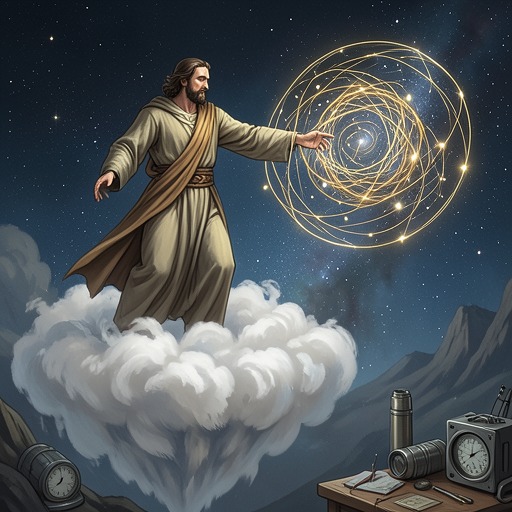
The rescuer is Asclepius, identified through his divine lineage as the son of Phoebus. Asclepius employs wondrous art and medicinal skill to restore Hippolytus to the light, acting in spite of Fate and the rigid will of Pluto. Resurrection therefore arises from a conflict between healing knowledge and the boundaries imposed by the underworld. The restoration is miraculous, but it is also represented as an act of skilled medicine: Hippolytus returns because Asclepius applies his extraordinary art to a body that death had already claimed.
The revived man does not emerge unchanged. His former hue has been altered, and the face and features now visible are unknown. Restoration thus includes bodily difference. The new body is recognizable as a transformed continuation of Hippolytus, but it cannot simply resume the old social identity, because the visible signs of his former self have been replaced.
Diana’s Renaming and New Life
Diana stands in doubt over where the restored Hippolytus should be concealed or established, considering either Crete or Delos. Both islands refuse him, and she chooses a wood instead. The rejected alternatives and the final woodland refuge give the new life a carefully bounded geography: Hippolytus cannot return to the former human order, nor can he be placed indiscriminately among sacred islands. His continuation requires another setting.
Diana commands him to abandon his former, luckless name because that name keeps alive the memory of his woes. The change from Hippolytus to Virbius is therefore not ornamental. It is a deliberate severing from the identity attached to accusation, exile, the chariot crash, and death. Yet the renaming also preserves the history it seeks to escape: the old name must be discarded precisely because it carries the memory of suffering so powerfully.
Diana grants him immortal life and declares that the man once called Hippolytus shall now be Virbius. The new name marks a second birth rather than a simple return. He becomes a god of an inferior rank, retaining a connection to the mortal life that preceded his resurrection while occupying a new sacred condition. His immortality is thus both compensation and displacement: he survives, but only after losing his former face, name, home, and place among ordinary humans.
Narrative Function and Significance
The event joins several kinds of transformation that recur throughout the larger mythic world: moral reversal, physical change, change of name, change of dwelling, and elevation into divine existence. Hippolytus’s story begins with an innocent man treated as guilty and ends with a figure whose altered identity reflects the rupture between his former life and his restored one. The narrative does not erase the original injustice; instead, it makes survival depend on passing through it.
Its pattern also reverses the usual finality of tragedy. The chariot wreck appears to close Hippolytus’s story, and the descent into the underworld confirms that closure, but Asclepius’s intervention reopens it. Even then, restoration is not a return to an untouched beginning. The changed face and the new name show that death has left a permanent mark, while Diana’s woodland choice supplies a setting in which the transformed survivor can exist without being forced back into the circumstances that destroyed him. Hippolytus is therefore revived as Virbius not by recovering the old world, but by entering a different order where loss becomes the condition of immortal continuation.